

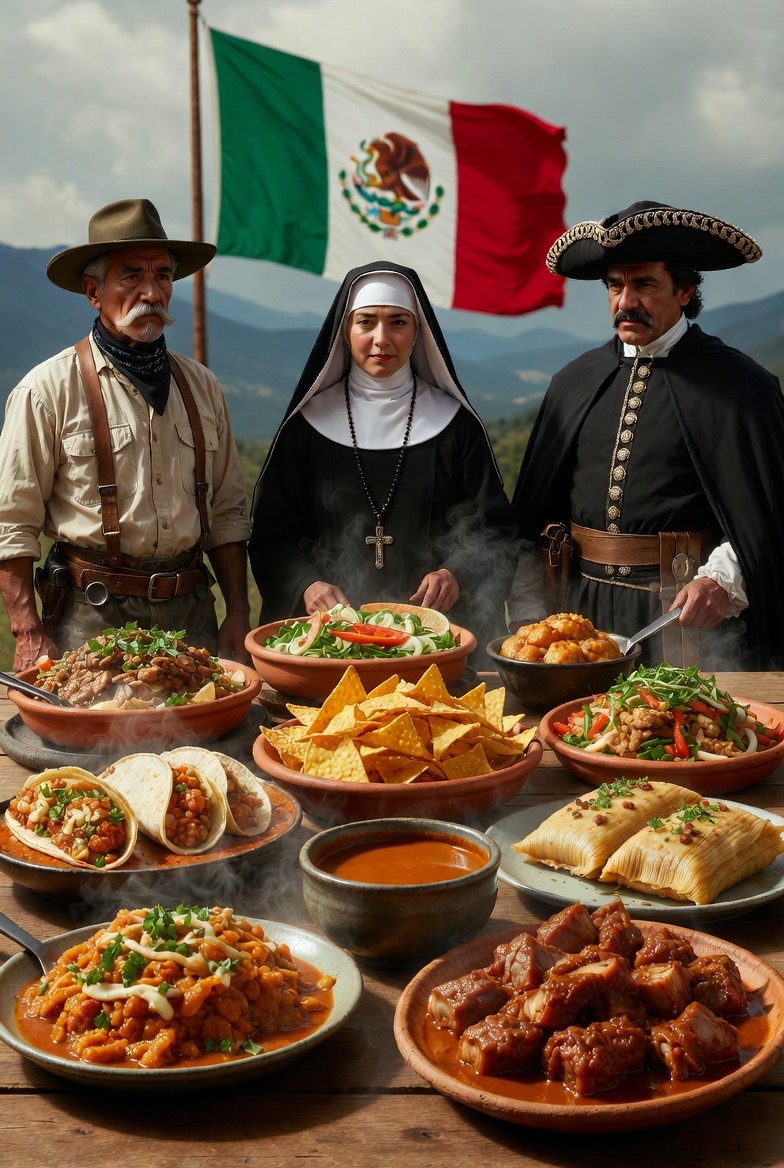
Mexican Food Was Never Supposed to Be Fancy
(And That’s Exactly Why It Works)
Mexican food didn’t come from chefs.
It came from people who were hungry, annoyed, occupied, invaded, broke, or late.
If you’re imagining a calm abuela gently perfecting recipes in a sunlit kitchen for centuries, let me ruin that for you right now. Most of Mexico’s most famous dishes were invented under some version of: “We’ve got five minutes, three ingredients, and the Spanish just showed up.”
Let’s start with the taco, because of course we will.
The original tacos weren’t cute. They weren’t plated. They weren’t even meant to be enjoyed slowly. Early tacos were working food—folded tortillas used by miners and laborers because plates break and hands don’t. One story traces them to Mexican silver mines, where gunpowder was wrapped in paper and nicknamed “tacos.” Eventually, someone applied the same logic to food: wrap it, stuff it, keep moving.
A taco isn’t a recipe.It’s a strategy.
Then there’s tamales, which look festive now but were basically prehistoric protein bars. Masa, fat, filling, wrapped in leaves—portable, durable, and steamable. The Aztecs fed them to soldiers, travelers, and anyone who needed to walk a long way without stopping at a café. They’re ancient survival food that accidentally became celebratory.
This explains why you never eat one tamal. They were designed for marching, not moderation.
Chiles en nogada, on the other hand, are Mexican cuisine putting on a tuxedo.
They were created by nuns in Puebla to impress Agustín de Iturbide, using the colors of the new Mexican flag. Green poblano, white walnut sauce, red pomegranate seeds. Patriotic, symbolic, seasonal—and wildly impractical. This is what happens when food stops being about hunger and starts being about politics.
Mexico does both very well.
Now let’s talk about mole, the dish everyone claims to understand and no one actually does.
Mole wasn’t invented. It happened.
Legend says a convent panicked when an important guest arrived and threw everything into a pot—chiles, chocolate, spices, nuts, bread, whatever wasn’t nailed down. The result took days, hundreds of ingredients, and somehow worked. Mole is culinary chaos theory. It’s proof that if you stir long enough, something meaningful might emerge.
Or at least edible.
Carnitas came from colonial compromise. The Spanish brought pigs. Indigenous cooks applied native techniques. Slow-cooked pork in its own fat was practical, preservable, and fed a lot of people without wasting anything. Carnitas are delicious because they were invented by people who couldn’t afford to throw food away.
That’s a recurring theme here.
Mexican food is not precious.
Even nachos, the most suspiciously Tex-Mex item of all, were born from improvisation. A border-town maître d’ in Piedras Negras had surprise guests, an empty kitchen, and some tortillas, cheese, and jalapeños. He cut, melted, served—and accidentally launched a global bar menu.
It’s clever.
It absorbs invasions, shortages, migrations, and mistakes, then turns them into comfort. It’s why the same country can give you street tacos that cost a dollar and ceremonial dishes that take three days to prepare.
Nothing was wasted. Everything was repurposed. Flavor was non-negotiable.
So when someone says Mexican food is “simple,” what they really mean is that it hides its intelligence well. Like a good traveler